What happened
On Tuesday, September 9, Tech for Democracy held Midterms: LFG, an hour on the races that will decide who writes the rules, the real risks to the vote, and the work that still moves numbers between now and Election Day.
Kara Weber opened with the reason we called it. The midterms will decide who writes the rules that determine the future of tech and democracy. We keep saying the right people need to be in the room when tech policy is written. We don't get to pick who is in that room unless we pick who is in office.
Then four people who do this work for a living told us how to close that gap: Hillary Lehr of Higher Ground Labs on the toss-ups, Taylor Ourada of Oath on giving that actually moves races, JoAnna Foyle on protecting the vote at the federal, state, and local level, and David Bowes of Swing Left and Mike Pfohl of Empower Project on turning organizing into votes.
Key takeaways
- We are fighting two battles at once. Going on offense against authoritarianism, and re-learning how to win. Both run through a handful of true toss-up races, because control decides who sits in the room when tech and AI policy gets written.
- Where you give matters more than how much. In 2024, 67% of Democratic Senate funding went to races decided by more than 5 points. Money aimed at the closest races does more work per dollar.
- Elections are not rigged, but they are contested at three levels. Federal courts set the guardrails, states set access, and counties run the actual experience of voting. Each one is a place where things can go wrong or be defended.
- AI is now part of the threat model. Fake candidates, fake voting information, and fake evidence of fraud are the three patterns to watch for, and the response is the same every time: don't share it, verify it.
- Persuasion runs through people, not institutions. Voters make up their minds hearing from people they know. Relational organizing is the highest-leverage volunteer work left in the calendar.
- Fifty-five days is enough time. Everything on this page can be started tonight.
It's all about the toss-ups
Hillary Lehr runs Fund V at Higher Ground Labs, a venture fund and ecosystem builder investing in technology for political progress from pre-seed to exit. She co-founded and led Quiller.ai, the first AI content platform built for campaigns, through its acquisition. She is also a Policy Fellow at Harvard Kennedy School's Ash Center, studying how AI is showing up in campaigns and election administration through the 2026 cycle.
She set the context for the midterms and made the case that we are fighting two battles at once. The first is going on offense against authoritarianism. The second is re-learning how to win. Both run through the toss-ups, because a small number of races decides control, and control decides who is in the room.
To make that concrete, we published our first Tech for Democracy resource: the T4D Guide to the Toss-Ups, a breakdown of where every Democratic candidate in a Cook Political Report pure toss-up race stands on tech and AI. Pure toss-up is the most competitive tier, where either party has a real shot.
Give where it moves the race
Taylor Ourada is co-founder and COO of Oath, a platform for donors who want their dollars to drive outcomes rather than headlines. She walked through the argument for targeting: most organizations optimize for win rate, which quietly rewards funding races that were never close. Oath optimizes for margin instead.
The numbers she showed: in the 2024 cycle, 67% of Democratic US Senate funding went to races decided by more than 5 points. Over two thirds of funding routed through Oath went to races decided by less than 5. Oath has directed more than $100M to candidates in the last two years.
She also encouraged everyone to use Oath to activate their own communities, which is exactly what our custom cart does. It is focused on the toss-up races.
Protect the vote
JoAnna Foyle is a founding member of Tech for Democracy. She has worked at the highest level of federal campaigns, on the National Finance Committees for Kamala Harris and Biden-Harris, and serves as an elected official in Greenwich, Connecticut. She broke the risk down by the level it lives on.
Courts and federal institutions set and enforce the national rules and constitutional guardrails. Right now federal courts are actively protecting mail voting, including a federal judge extending a block on a new federal mail-ballot rule through the 2026 election.
States write most of the rules on registration and how people cast ballots, so access varies a lot by where you live. In May 2026 Connecticut enacted Public Act 26-42, letting every eligible voter vote absentee without giving a reason.
Counties and local election officials run polling places, poll workers, equipment, and voter services. Webb County, Texas recently moved one of its busiest polling locations over accessibility and privacy concerns and added new locations.
Across all three levels she pointed at four factors that determine whether the vote holds up: information, systems, trust, and scale. Technology moves every one of them, in both directions.
Three things every voter should watch out for
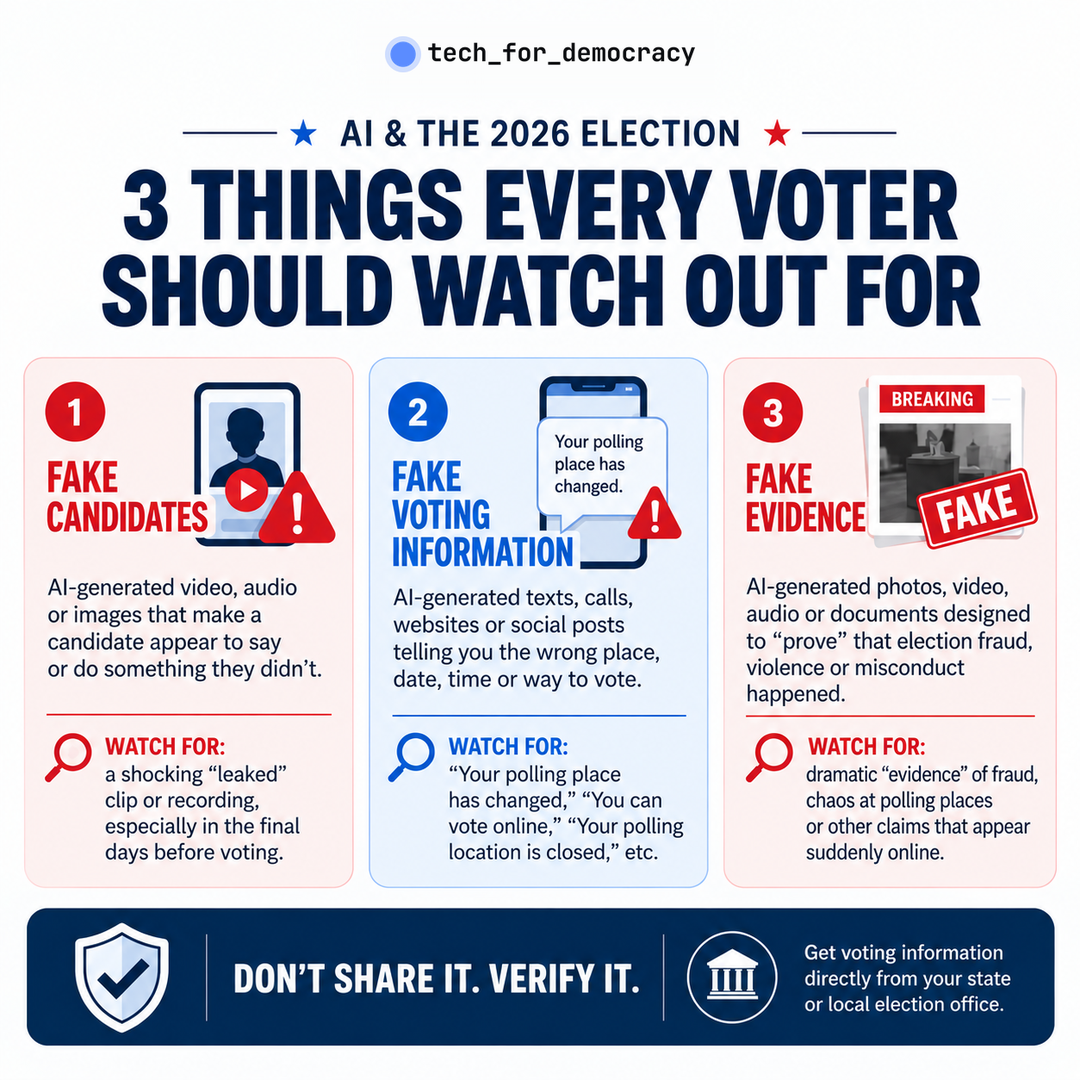
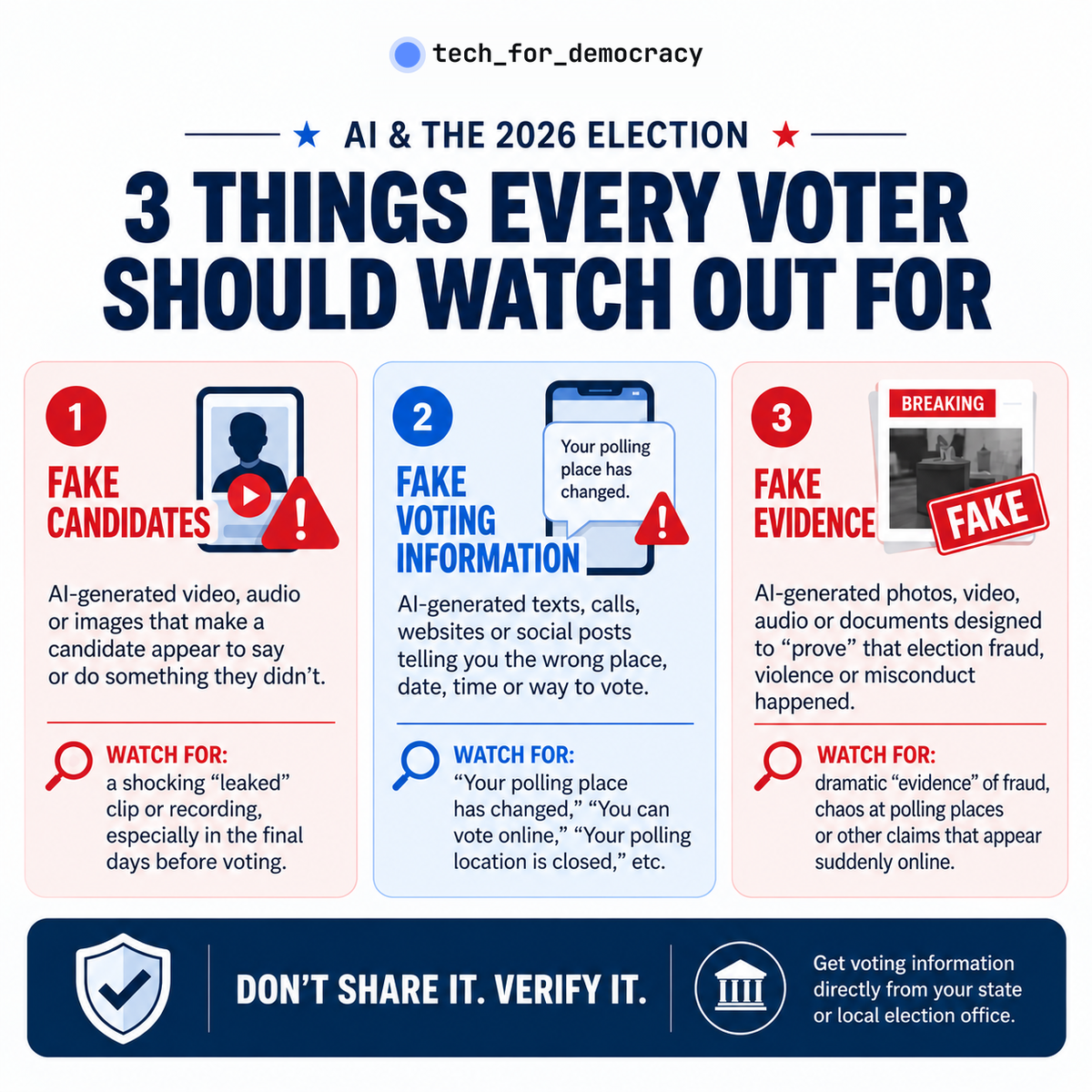
We built a graphic on AI and the 2026 election covering the three patterns to watch: fake candidates (AI-generated video or audio making a candidate appear to say something they didn't), fake voting information (texts, calls, or posts giving you the wrong place, date, or way to vote), and fake evidence (AI-generated material designed to prove fraud or chaos that never happened).
The response is the same in all three cases. Don't share it, verify it. Get voting information directly from your state or local election office.
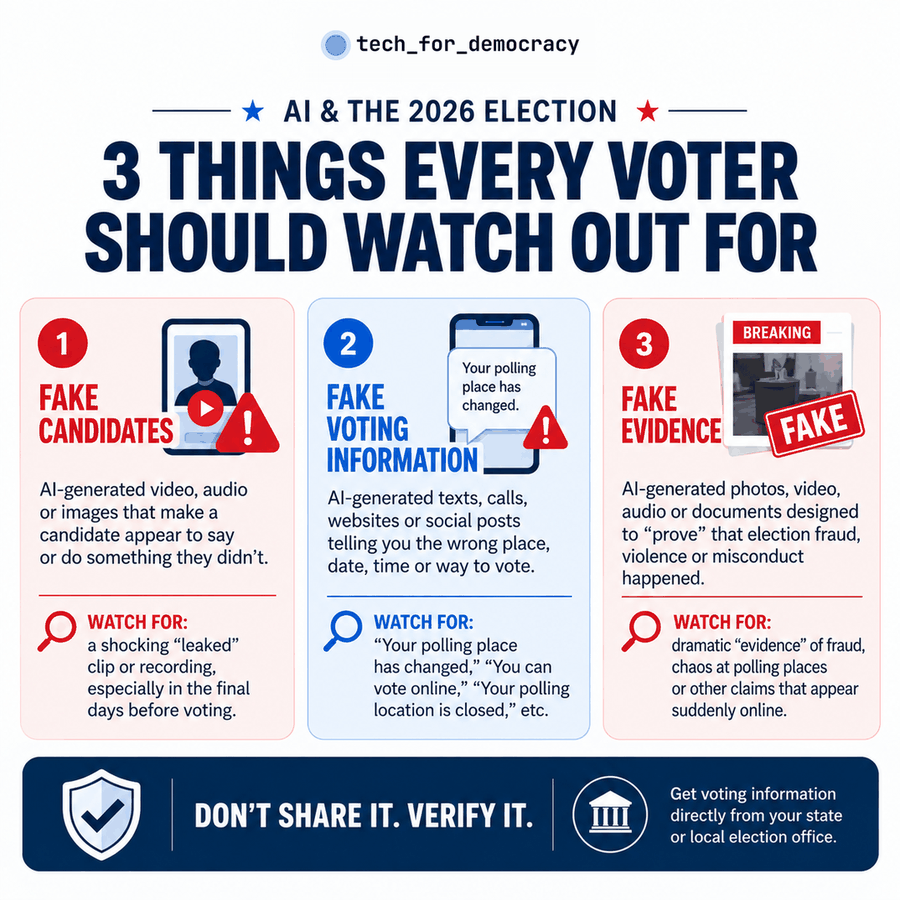
Post it. Both sizes are ready to go.
It's not too late to activate
Every technologist on that call has shipped something that changed behavior at scale. The last two speakers do that for elections.
David Bowes joins Swing Left as Senior Advisor. Swing Left is the largest year-round home for Democratic grassroots electoral volunteers and donors. Since 2017 its community has helped raise more than $140M, contacted more than 50M voters, and built a network of more than 1M members and 400 local groups. David is Founding Principal of Bowes & Co. Strategy + Public Affairs and was Chief of Staff to the National Co-Chairs of the Harris-Walz and Biden-Harris campaigns. He introduced Swing Left's newest initiative, Ground Truth, and asked this room to volunteer with it. Ground Truth is built for a moment when get-out-the-vote work itself is changing. It is not only about turning out voters, it is about listening to them and learning what actually works.
Mike Pfohl is President and Founder of Empower Project. He helped start the relational organizing movement during the 2011 Wisconsin recalls and built the first relational organizing tool. He defines relational organizing simply: using real relationships and private communications to influence voters. His argument is that politics is no longer shaped by institutions speaking at voters, it is shaped by people speaking to one another. Voters make up their minds hearing from friends, not from ads. But most progressive infrastructure is still built for the old way.
Empower runs two lines of work. Free training and free technology for other organizations and campaigns, and its own programs in key states, where it recruits and trains tens of thousands of ordinary people to talk to their own friends and family about the election.
Featured speakers
On why these midterms decide tech and AI policy, and why the toss-ups are where the leverage is.
On precision political giving, and why funding the closest races beats optimizing for win rate.
On federal, state, and local risks to the vote, and the concrete ways to help protect it.
On how get-out-the-vote work has changed, and Swing Left's Ground Truth initiative.
On relational organizing, why it works, and how to run it with your own network.
Kara hosted. Mark closed with the asks. Elizabeth Raymond ran everything you didn't see.
Pick one
Don't leave this page without picking one.
- Read the guide. The T4D Guide to the Toss-Ups, where every Democratic candidate in a pure toss-up race stands on tech and AI.
- Give where it counts. The T4D toss-up cart on Oath, or search Impact Scores and build your own. Oath's briefing is September 15.
- Protect the vote. Join the private DNC Protect the Vote briefing, and post the AI voter protection graphic to LinkedIn and Instagram.
- Volunteer with Ground Truth. Sign up with Swing Left to turn out voters and learn what is actually working.
- Talk to people you know. Sign up through Empower to reach your own friends, family, and neighbors before November 3.
- Bring your org. Book a demo if you run a campaign or nonprofit that should have a relational program.
- Show up next time, and bring someone. Register for October 6.
- Tell us how we did. Three questions, that is the whole survey.
- Raise your hand. Fill out the form below and tell us where you want to plug in.
What's next
Our next event is October 6. The single best thing you can do is bring one person with you.
We are also organizing our volunteers, and there is something bigger coming. In the weeks ahead we will share concrete details on what it means to become a member of Tech for Democracy.
"We don't get to pick who's in the room unless we pick who's in office. You just spent an hour with the people doing exactly that. Now go pick your race, your click, your door."
Get involved
If you want to help build Tech for Democracy, we need people who can organize, recruit, and contribute in all sorts of ways. Fill out the form below to raise your hand.
← Back to Tech for Democracy